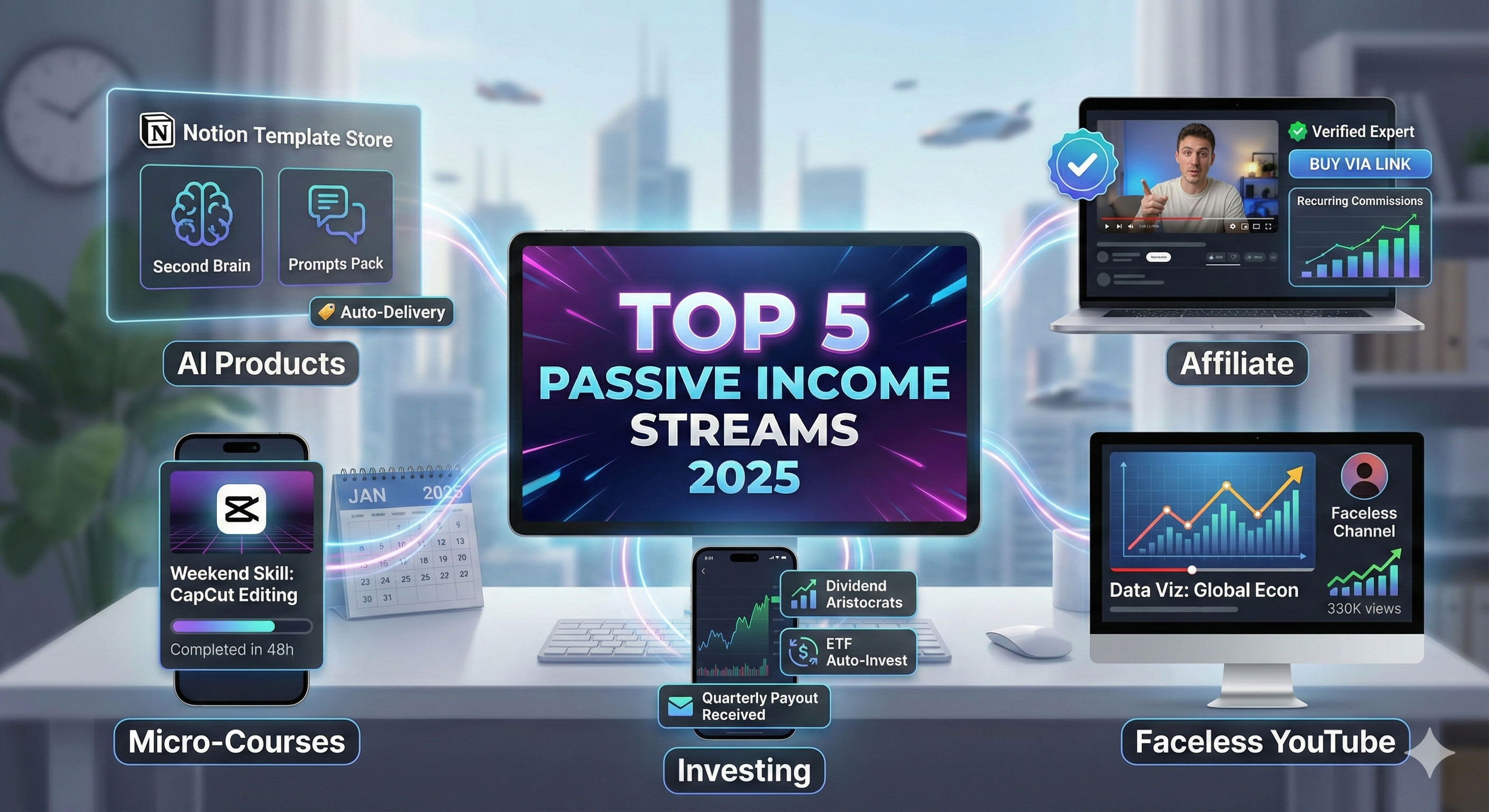
This is one of the most sought-after topics in personal finance. However, as we move into 2025, it is crucial to start with a realistic definition of "passive income."
The Reality Check: True passive income—where you do absolutely nothing and money appears—is rare unless you already have significant capital to invest.
For most people, "passive income" in 2025 means front-loading effort. You spend weeks or months building a digital asset, and once it is established, it requires minimal maintenance to generate recurring revenue. The goal is to divorce your income from your hourly labor.
The landscape in 2025 is defined by market saturation in some areas and the massive integration of AI tools that make creation faster, but quality harder to distinguish.
Here are the top 5 realistic ways to earn passive income online in 2025, accounting for current technology and trends.
1. Selling AI-Leveraged Digital Products and Templates
Selling digital files is a classic passive model: you make it once and sell it infinitely with zero shipping costs. In 2025, the key is using generative AI to speed up creation, while applying human curation to ensure high quality.
The market is flooded with generic AI junk. The money is now in specialized, highly functional, or aesthetically unique products that AI helps make but a human finalizes.
What works in 2025:
Notion Templates: The productivity ecosystem is massive. People will pay $20–$100 for a complex "Second Brain," business operating system, or student planner built in Notion.
Specialized Prompts: Selling packs of highly engineered prompts for Midjourney, ChatGPT, or Claude for specific industries (e.g., "Architectural Rendering Prompts" or "Legal Contract Review Prompts").
Printables & Spreadsheets: Budget trackers for Google Sheets, wedding planners on Etsy, or intricate coloring books for adults generated via AI and cleaned up in Photoshop.
Why it’s passive: Once the file is uploaded to Etsy, Gumroad, or your own Shopify store, the delivery is automated. Your only job is customer support and occasional updates.
2. Niche Authority Websites with "Authentic" Affiliate Marketing
Affiliate marketing (earning a commission for recommending someone else’s product) changed drastically between 2023 and 2025.
The internet was flooded with AI-written, low-quality review sites. In response, Google and consumers now aggressively filter for "Authenticity" and "Experience" (E-E-A-T). You can no longer just summarize Amazon reviews.
To succeed now, you must build a brand based on actual trust within a specific niche.
What works in 2025:
The "Hybrid" Review Site: A blog that uses video proof. Don't just write about the best hiking boots; embed a YouTube video of you wearing them on a trail.
B2B Software Reviews: Businesses spend money readily. Deep-dive comparisons of obscure business software (e.g., "Best CRM for Dental Practices") pay high recurring commissions.
Video-First Affiliate Links: Using TikTok, Instagram Reels, or YouTube Shorts to demonstrate a product, with the affiliate link in your bio.
Why it’s passive: An "evergreen" review article or video created in January 2025 can still drive traffic and sales in December 2027 if the product remains relevant.
3. Creating and Selling "Micro-Courses"
The era of the $2,000, 40-hour mega-course is declining. People in 2025 are busy and have shorter attention spans. They want a specific outcome in the shortest possible time.
Instead of trying to teach "Everything About Digital Marketing," teach one specific skill.
What works in 2025:
The "Weekend Outcome": Courses designed to be consumed and implemented in 48 hours. Examples: "Set up your first Facebook Ad campaign," "Learn basic video editing in CapCut," or "Master VLOOKUP in Excel."
Cohort-Based Materials: If you run live courses, package the recordings, worksheets, and templates and sell them as a lower-ticket "self-paced" version.
Platforms: Hosting these on platforms like Teachable, Kajabi, or even marketing them through platforms like Skillshare (though Skillshare is more about royalties than direct sales).
Why it’s passive: Once recorded and edited, the course runs itself. You use automated email funnels to sell it to new leads without lifting a finger.
4. The "Faceless" YouTube Automation Channel
YouTube remains a powerhouse for passive income via AdSense revenue, but many people don't want to be on camera.
"Faceless" channels use stock footage, animations, motion graphics, and high-quality voiceovers to deliver content. While AI voiceovers (like ElevenLabs) made this easier, audiences prefer human voices or exceptionally realistic AI.
The key in 2025 is high-quality storytelling and editing, not just churning out cheap content.
What works in 2025:
Data Visualization & Economics: Channels that explain complex financial events using graphics.
True Crime / Mysteries: Highly researched narrative storytelling paired with eerie stock visuals.
Niche History: Deep dives into obscure historical events rather than generic summaries of WWII.
Why it’s passive: YouTube is a long-term asset game. A library of 100 videos works for you 24/7. Videos you made three years ago will continue to accrue views and ad revenue every single day.
5. Dividend Investing and Automated Index Funds
This is the only truly "passive" option on the list, as it requires capital rather than time. However, thanks to modern fintech apps, the barrier to entry is near zero.
While high-yield savings accounts were great in 2023/2024, interest rates are cyclical. For long-term passive growth in 2025 and beyond, you need exposure to the market.
What works in 2025:
Dividend Aristocrats: Investing in companies that have consistently paid and increased dividends for 25+ years. They pay you quarterly just for holding their stock.
Broad Market ETFs (VTI/VOO): While not focused purely on income, buying the whole stock market and setting it to "auto-invest" every month is the surest path to passive wealth building over decades.
Fractional Shares: Using apps like Robinhood, M1 Finance, or Fidelity to automatically invest $50 a week into dividend-paying assets, regardless of the full share price.
Why it’s passive: This is the definition of "making your money work for you." You set up an automatic transfer and never look at it again until you need the income.
Top 5 Ways to Earn Passive Income Online in 2025